Beyond Seniors
Caring for a sibling after a traumatic brain injury The role reversal no parent-caregiving guide prepares you for
Updated September 2026
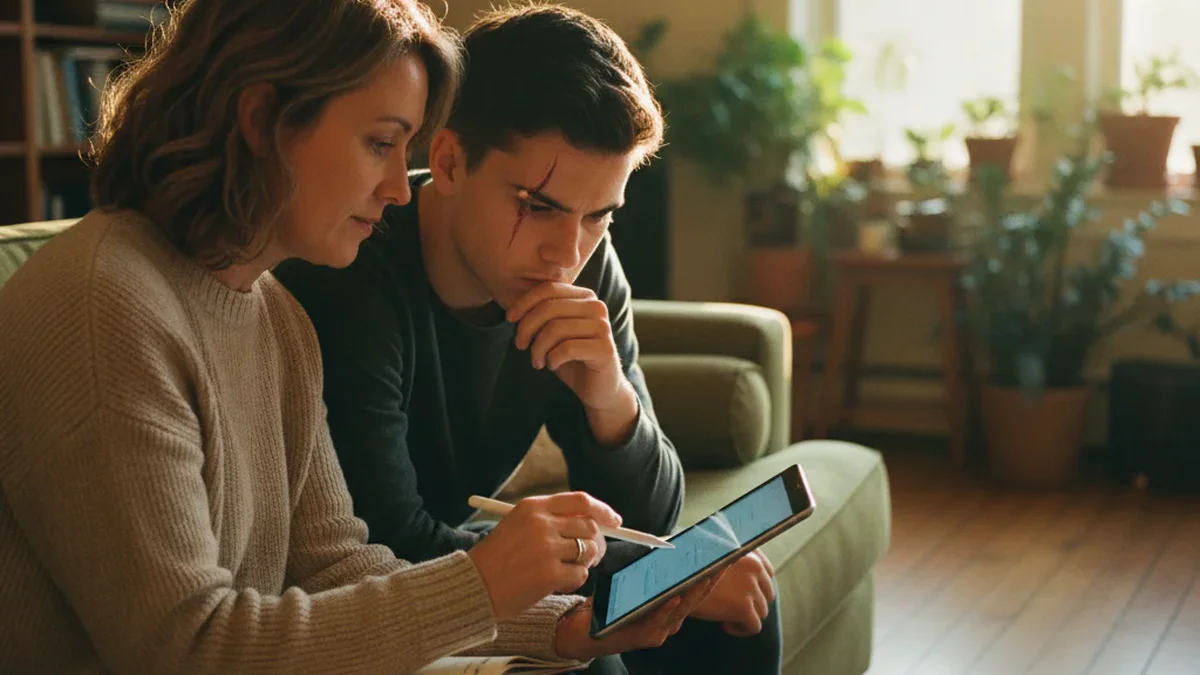
Article images are AI-generated illustrations. Some may include AI-generated people; they are illustrative and do not depict real caregivers, patients, experts, or FamilyCareWise contributors.
TL;DR: TBI changes personality, memory, and physical ability, and a sibling steps into an authority role a peer relationship never had. Paced rest and short written steps help daily. The Brain Injury Association of America runs a state network and a helpline. The grief is real and rarely named.
A traumatic brain injury changes memory, mood, and physical ability, often all at once, and it turns a sibling relationship into a caregiving role that relationship was never built for. What helps, and where support exists, follow below. That shift does not wait for you to be ready.
The CDC counted about 214,110 TBI-related hospitalizations in 2020 and 68,663 TBI-related deaths in 2023. Those totals leave out every milder injury treated in an emergency room, an urgent care clinic, or nowhere at all, so the real annual number runs higher. Most caregiver resources on this and other sites are still written for adult children caring for aging parents. When the person you are caring for is a sibling, several things change, and this guide is built around that, because you grew up together, with years of a specific relationship behind you.
Now you are managing medication schedules, cognitive fatigue, and a personality that does not always match the person you knew. What follows is organized the way the work actually lands. What changes, what the role itself costs, what helps day to day, home safety, and where to find people who understand it.
What actually changes after a TBI
Not every TBI looks the same. The Model Systems Knowledge Translation Center's own overview states plainly that "a TBI can range from mild to severe in effect." Doctors estimate that range from a person's level of consciousness in the hours after injury. A second marker is how long they stay confused or cannot form new memories afterward, called post-traumatic amnesia. A sibling with a mild TBI, often called a concussion, may recover most functioning within weeks. Rest and a gradual return to normal activity are usually enough. A sibling with a moderate-to-severe TBI faces a longer, less predictable recovery. That is the population this guide focuses on, since sustained family caregiving is most often needed there. It is also the population behind the cognitive, physical, and behavioral changes described below.
A brain injury sets off changes across several systems at once, and the full picture usually takes months to come into focus. Memory, attention, and processing speed are affected in most cases. The Model Systems Knowledge Translation Center, the federally funded TBI rehabilitation research network, describes it plainly. People with TBI "may have trouble learning and remembering new information and events," and may have trouble "paying attention or staying focused." Multi-step tasks completed in order, such as cooking, are often affected too. The same factsheet describes processing speed the same way: "a person's ability to process and understand information often slows down and can become more challenging," so a conversation that used to be easy can now take real effort to follow.
Behavioral and emotional change is often the hardest part for a family to sit with. The same MSKTC factsheet lists a tendency toward "acting quickly without thinking about the possible consequences," and, separately, a reduced awareness of the changes themselves: "being unaware of cognitive problems, even if the problems are clear to others." That reduced self-awareness has a clinical name, anosognosia, and the National Institutes of Health defines it as a neuropsychiatric condition in which a person is unconsciously unaware of a deficit, not simply reluctant to admit one. A sibling who insists nothing is wrong may not be in denial. The brain injury itself may be the thing blocking the recognition.
Fatigue belongs on this list too, and it is one of the most underestimated parts of recovery. The same MSKTC network's factsheet on fatigue after TBI describes three overlapping kinds, physical, psychological, and mental, and notes that "as many as 70% of survivors of TBI complain of mental fatigue." It is not the tiredness of a long day. Even a short conversation can leave someone exhausted in ways an outside observer cannot see, and physical changes, balance trouble, headaches, and light or noise sensitivity, often ride alongside it.
The specific weight of sibling caregiving
Most caregiver support material assumes a familiar shape: a younger generation stepping in to support an older one. Sibling caregiving does not fit that shape at all. You and your sibling were peers, with a shared history that was yours alone, and the caregiving role now sits on top of it. You are managing appointments, supervising daily tasks, or making decisions for someone who used to be your equal. That reversal is disorienting in a way that is specific to siblings, and it is rarely discussed in family caregiving material.
That reversal can turn into a legal question, not just an emotional one: if your sibling's TBI leaves them unable to manage their own medical or financial decisions, someone else needs the legal authority to make those decisions instead. MSKTC's guidance on severe brain injury is direct about it: "A guardian has the legal authority to make medical and/or financial decisions for someone who lacks the ability to do so," and "if you think that your loved one may need a guardian, you will need to contact an attorney for help." For a parent, that authority is often already in place through a healthcare proxy or power of attorney signed years earlier. For an adult sibling, it usually is not. A family can find itself starting the guardianship process from scratch at the same time it is still learning what the injury means day to day.
Sibling caregivers are also frequently at a demanding life stage of their own, in their 30s, 40s, or 50s, often with careers, children, and a household to run in parallel. Two of our other family-caregiving guides land near this same gap. Young-onset dementia caregiving covers a parallel situation. A diagnosis arrives before the caregiving guides written for aging-parent situations apply, and it raises its own job loss and Medicare-gap questions. A TBI or a progressive brain condition can also change a person's behavior toward the people closest to them. Caring for a family member with a serious mental illness covers what a family conference and outside support can and cannot resolve. Neither guide is about a sibling specifically. The structural gap they describe, a caregiving role that no existing family script anticipated, is the same one.
That gap is not abstract. MSKTC's own factsheet on how TBI affects families names "financial difficulties" and "less time for yourself" alongside "role changes of family members" as problems many families experience. For a sibling still building a career, that strain lands differently than it does for a retired parent. Turned-down travel, declined promotions, cut hours, and savings meant for your own household going toward your sibling's care instead are all common. Even so, no one in the family usually names it directly.
What helps, day to day
Structure carries more weight here than reminding or correcting in the moment. Whiteboards, sticky notes, and a simple written schedule support a sibling whose short-term memory is affected. A smartphone alarm for medication is more reliable than a verbal reminder, and keeping a daily sequence the same, the same order every morning, reduces the cognitive load of deciding what comes next. When giving instructions, shorter is better: one step, a pause, then the next step, gives the brain room to process.
Fatigue needs active pacing, not willpower. MSKTC's fatigue factsheet recommends doing "things that require the most physical or mental effort earlier in the day when you are fresher," with rest scheduled into the day, not squeezed in only after fatigue forces a stop. Cognitive tasks, reading, conversation, working through a decision, are fatiguing on their own, separate from anything physical. Save corrections for what actually matters: safety, medication, an important decision. Let smaller errors pass. Correcting every one is exhausting for both of you, and most of them carry no real risk.
A simple log of symptoms and behavior over time is worth keeping. Recovery after TBI is gradual and uneven. Week-to-week progress is often hard to feel on its own. A log gives you something concrete to bring to a short appointment, since a provider otherwise only sees a single snapshot.
Home safety after a TBI
Where balance, dizziness, or mobility are affected, the home itself needs to change. Low-cost first steps take an afternoon. Clear loose rugs and cords from walking paths, add non-slip mats to the shower and any slippery floor, and improve the lighting in hallways and on stairs.
Grab bars near the shower and toilet are usually the highest-value structural change where balance is affected. The article on grab bars: what to install, where, and how to do it right covers placement and weight ratings in detail.
A medical alert device with fall detection is worth considering for a sibling who spends time alone. MSKTC's factsheet on transitioning home after rehabilitation recommends asking about a home evaluation: "an occupational therapist, physical therapist, or other rehabilitation professional goes to your home to assess your needs in a real-life setting," including "the need for railings, grab bars, ramps, or other changes to your home environment." Ask the rehab team about this before discharge, or a doctor can refer you to one directly afterward.
The grief that runs alongside the caregiving
Your sibling survived. But the person you knew, the particular sense of humor, the way they handled stress, the things they cared about, may still be altered. That can feel like loss, even though no one died. Our guide to caring for a spouse with dementia names this same pattern, grief for someone who is physically present but changed, as ambiguous loss. Other relationships carry the same grief, and it does not require a death to be real.
Family conflict often rides alongside the grief. A sibling who is not doing the primary caregiving may see the situation differently. Parents may be working through their own grief, and old family dynamics tend to intensify under pressure. MSKTC's caregiver stress factsheet, cited again below, notes that family counseling sessions "focus on helping with communication, defining roles, or coordinating care," which is a more concrete option than working it out alone.
Sustained caregiving without support leads to burnout, and TBI caregivers often deprioritize their own health while managing someone else's. MSKTC's factsheet on caregiver stress puts the case for self-care directly: "you're no good to anyone else if you're not good to yourself." It recommends keeping personal activities, scheduling time for things you enjoy, and drawing on family, friends, other caregivers, or professional counseling instead of carrying the role alone.
Where to find support built for TBI families
The Brain Injury Association of America runs the National Brain Injury Information Center helpline at 1-800-444-6443. It also runs a nationwide network of chartered state affiliates that provide direct support and advocacy for people living with brain injury and their families. A state affiliate is a practical way to find people locally who understand a TBI household specifically, not caregiving in general.
Hospital rehabilitation programs are another practical starting point. If your sibling went through inpatient rehab, the rehab social worker or case manager usually knows the local TBI community resources and can make a direct introduction.
The Caregiver Action Network lists traumatic brain injury among its condition-specific caregiver resources and runs a caregiver help desk at (855) 227-3640. It offers education, peer support, and resources to family caregivers free of charge. Its general burnout and self-care material applies here too, on top of anything TBI-specific.
Frequently Asked Questions
What changes after a sibling has a traumatic brain injury?
Memory, attention, and processing speed are the most commonly affected areas. A sibling may ask the same question repeatedly, lose track of a multi-step task like cooking, or take longer than before to follow a conversation. Behavior can also shift toward impulsivity, and self-awareness of the changes is often reduced, so a sibling may not recognize a problem that is obvious to everyone else. Fatigue and physical effects such as balance trouble, headaches, and light sensitivity commonly layer on top.
How is caring for a sibling with TBI different from caring for a parent?
It disrupts a peer relationship. A parent-child relationship already carries some built-in authority; a sibling relationship does not. You grew up as equals, and the caregiving role now carries a kind of authority over someone who was once your closest confidant or your oldest rival. Most caregiver resources are written for adult children caring for aging parents, so a sibling caregiver often has less recognition, fewer age-matched peers in a support group, and a family script that does not explain what a sibling in this position is supposed to do.
What home safety changes help after a brain injury?
Removing loose rugs and cords, adding non-slip mats, and improving hallway lighting are low-cost first steps that take an afternoon. Grab bars near the shower and toilet are usually the highest-value structural change where balance is affected. A medical alert device with fall detection is worth considering for a sibling who spends time alone. Where deficits are significant, an occupational therapist can run a formal home safety assessment matched to the specific impairment, not a generic checklist.
Where can TBI caregivers find support?
The Brain Injury Association of America runs a National Brain Injury Information Center helpline at 1-800-444-6443 and a nationwide network of chartered state affiliates. The Caregiver Action Network lists traumatic brain injury among its condition-specific caregiver resources and runs a caregiver help desk at (855) 227-3640. A rehabilitation hospital's social worker or case manager, if your sibling went through inpatient rehab, is often the fastest route to a local TBI support group.
The information on this page is for educational purposes only and does not constitute medical, legal, or financial advice. Every family's situation is different. Please consult a qualified healthcare provider, licensed attorney, or certified financial planner for guidance specific to your circumstances.