Safety & equipment
Gait belt for elderly Moving a parent safely at home
Updated September 2026
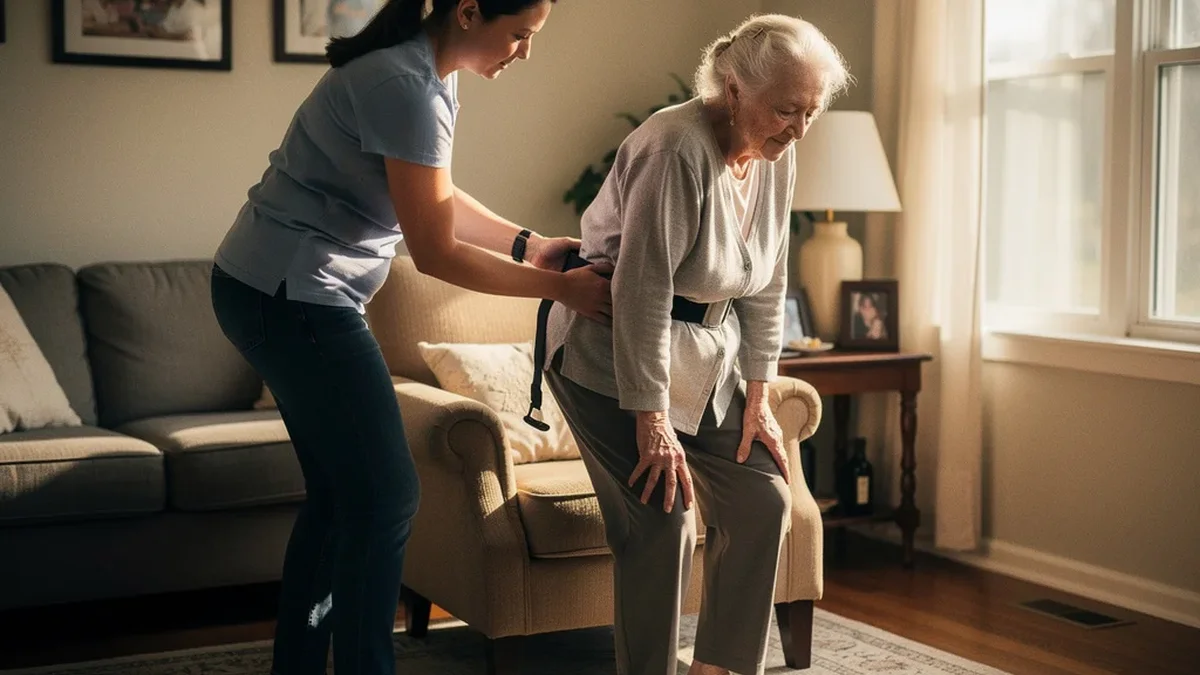
Article images are AI-generated illustrations. Some may include AI-generated people; they are illustrative and do not depict real caregivers, patients, experts, or FamilyCareWise contributors.
TL;DR: Caregiver injuries usually happen when a planned transfer turns into a lift partway through, according to Canada's occupational health agency. Check what a parent can do before every single move. A belt improves your grip. The biomechanical evidence that it lowers spine load is mixed.
A gait belt gives you a secure grip while a parent stands or walks. Occupational health guidance draws the line at weight-bearing: moving someone who cannot bear weight on at least one leg should always involve a mechanical lifting device.
Transfer equipment is easy to shop for. Belt, board, disc, lift, each with a price beside it. Shopping first gets the sequence backwards. The Canadian Centre for Occupational Health and Safety is Canada's national occupational health and safety agency, and its safe patient handling fact sheet names the injury pattern: "Injuries to caregivers during patient transfers usually occur when a transfer suddenly becomes a lift." The device is downstream of that. What has to come first is knowing which of the two you are about to do.
Weight-bearing decides whether this is a transfer or a lift
The same CCOHS fact sheet, last revised in January 2025, draws a formal distinction that most family caregivers have never been given, and a transfer, it says, "is a dynamic effort in which the client aids in the transfer and is able to bear weight on at least one leg." A lift "involves moving a client who cannot bear weight on at least one leg," and its guidance is that "lifts should always involve mechanical lifting devices."
MedlinePlus is the National Library of Medicine's patient information service. Its instructions for moving a patient from bed to a wheelchair, reviewed in October 2025, use the same threshold. The technique it describes "assumes the person can stand on at least one leg," and it adds: "If the person cannot use at least one leg, you will need to use a lift to transfer them."
There is a second, stricter line inside the first one. It decides whether you can do the move alone, and Patient Care Transfer Techniques is a StatPearls review on the National Library of Medicine's Bookshelf, by Rachel Bergman and Orlando De Jesus, last updated in October 2022. It puts that line as a condition on the one-person version: "A one-person assist may be performed if the patient can bear weight on both lower extremities and predictably take small steps. If these criteria are not met, a 2-person transfer or a mechanical lift may be necessary to transfer the patient safely."
Read together, those two sources describe three bands, not two. The three-band frame is our reading of them, not a line either source draws. One leg and some participation puts you in transfer territory. Two legs plus predictable small steps is what the literature attaches to doing it by yourself. Neither leg means a machine. A parent can move between those bands within a single week, or within a single afternoon. That is why CCOHS asks caregivers to "assess the client, even briefly, before every transfer". The question does not get settled once, on the day the equipment arrives.
Before you buy anything: Ask the discharging hospital or the parent's doctor for an occupational therapy referral. Ask the therapist which band your parent is in and what equipment matches it. Medicare Part B helps pay for medically necessary outpatient occupational therapy if a doctor or other health care provider certifies you need it, and Medicare's page also states there is no limit on how much it pays for medically necessary outpatient therapy services in one calendar year. After the Part B deductible you pay 20% of the Medicare-approved amount. That is a coverage description, not a promise about your parent's plan, so confirm with the provider before the visit.
Gait belts give you something firm to hold
The MedlinePlus bed-to-wheelchair instructions describe the belt's job in one line: "If you have a gait belt, place it on the person to help you get a grip during the transfer." That is the whole function. The alternative, which the same guidance rules out, is holding onto the person themselves. CCOHS says plainly: "Never grab the client under their armpits as this grip could injure the person." MedlinePlus's separate instructions for pulling a patient up in bed repeat it for that specific move: "Never move a person up by grabbing them under their arms and pulling. This can injure their shoulders."
The belt is also the alternative to gripping clothing. Foundations for Assisting in Home Care is an open textbook published by Milne Publishing at SUNY Geneseo for home health aides and personal care aides. It makes the same point about a lift sheet: grasping the edges of the sheet "rather than grasping the patient's body parts or clothing" prevents injury to both people, and the same logic puts the belt between your hands and the person.
Putting the belt on
The home care textbook's instruction is short. "The belt should be applied over the patient's clothing and around their waist. Never apply a gait belt to bare skin as it could cause skin breakdown." Its bathing procedure repeats the requirement that the person have a shirt or towel on with the belt over it, for the same reason.
For the hold itself, that source says to "grasp the gait belt securely in both hands, with one hand on either side of the patient's waist as you stand in front of them." In the version of the move without a belt, it says to "hold the patient close to your center of gravity," which "provides balance and stability." StatPearls gives the same distance rule from the clinical side: providers "should always stay close to patients during the transfer to keep the patient's weight close to the provider's center of gravity."
Standing a parent up from a bed or chair
Preparation carries more of the safety than technique does. MedlinePlus asks you to explain the steps to the person first, then park the wheelchair next to the bed, parallel or at a slight angle, and put the brakes on, and to move the footrests out of the way and clear loose rugs. MedlinePlus adds that you may want to put non-skid socks or shoes on the person's feet if they need to step onto a slippery surface, and the home care textbook makes footwear a required step: "Ensure the patient has on socks and non-skid shoes."
Sitting comes before standing, and it has its own pause built into it. MedlinePlus says to let the person sit for a few moments in case they feel dizzy when first sitting up, then move them to the edge of the bed and lower the bed so their feet are touching the ground. The home care textbook extends the pause to the standing position. It says to allow the person "to stand in place for 1-2 minutes to ensure that they are steady on their feet." If dizziness or faintness persists, help them back into a sitting position and inform their supervisor. A family caregiver has no supervisor, so that last instruction routes to the parent's own clinician.
For your own body during the stand, the textbook is specific. Face the person and place your feet about 12 inches apart. Use the strength of your thigh muscles as your base of support, bend your knees slightly, and keep your hips and back aligned, and brace their knees by placing the inside of your knees against the outside of theirs. MedlinePlus adds the count and the destination. Count out loud to three and stand slowly. Use your legs to lift, shift your weight from your front leg to your back leg, and have the person help push off the bed.
One instruction shows up in three independent sources, which is unusual enough to be worth naming. MedlinePlus: the person can hold onto you or reach for the wheelchair, but "they should not wrap their arms around your head or neck." StatPearls: "Be careful not to let patients wrap their arms around the provider's head." CCOHS: "Never allow the patient to grasp you around the neck as this action could result in injury."
If a parent starts to go down: MedlinePlus instructs that you lower them to the nearest flat surface, bed, chair, or floor. It also says to contact their health care provider if they fall. The home care textbook describes the same move in more detail. Widen your stance and bring their body close to you for support, then bend your knees and use the strength of your thighs to lower them to the floor, or to the bed if you can. It also says that if the person has fallen, do not attempt to get them up alone. These are reported instructions from those sources, not a substitute for the emergency advice of a clinician who knows your parent. Any fall with a head strike, a suspected fracture, or a loss of consciousness is an emergency call.
Slide boards move someone who cannot stand
A slide board, also called a transfer board, bridges two surfaces so a seated person crosses without standing. The home care textbook describes it as being used "to help a patient transfer to a bed, chair, or bath stool when they are unable to walk or bear weight on their legs."
Who it suits is narrower than that sentence makes it sound, and StatPearls is the source that draws the boundary, and a sliding transfer board "can benefit patients with paraplegia, lower-extremity amputation, and decreased balance or strength in the lower extremities." It then rules out three groups by name. Someone with quadriplegia "would not have the postural support or upper extremity strength to use a slide transfer board." Someone who can do a stand pivot transfer "would not need" one. And "a patient who cannot follow commands does not benefit from a slide transfer board." The home care textbook adds the strength condition in plainer words: a slide board "should only be used for patients who have the strength to move themselves across it."
The setup is a sequence, and skipping a step in it is how boards go wrong. StatPearls: place the wheelchair close to the bed and apply the brakes, remove the armrest, and swing the footrests away, then place the board under the person's buttock and leg so they cannot fall off it. Keep fingers out from under the board to avoid pinching them. The board "should extend the distance between the bed and the wheelchair." The home care textbook places the wheelchair or chair at a 20-degree angle facing the surface they are moving to. It asks the person to lean away from the board so you can slide it under.
What goes wrong with slide boards
Friction is the recurring problem, in both directions. The home care textbook is direct about the person's skin. Ensure they have clothing on so the board does not touch bare skin, because "rubbing against the slide board with bare skin can cause injury to the patient's skin." It follows with the rule that covers most of the failure cases: "Never drag a patient across the slide board. Always use a series of small movements to assist them cross the slide board." The MedlinePlus guidance for moving someone in bed names the areas that friction damages first, which are the shoulders, back, buttocks, elbows, and heels, and asks you to contact the person's provider if you see redness or sores on the skin.
Too little friction is the other failure, and the fix StatPearls records for it is a household object. Say a person moves from a wheelchair into a car seat or a bed and their clothing sticks to the surface fabric. The review says to "place a plastic garbage bag over the surface to decrease friction when sliding."
Protecting your own back means not taking the weight
The CDC's National Institute for Occupational Safety and Health states the risk ranking on its safe patient handling and mobility page, last reviewed in May 2024, and it reads: "The single greatest WMSD risk factor for healthcare workers is patient handling." Patient handling there covers manual lifting, moving, and repositioning. NIOSH describes the mechanism with its own modality intact, which is worth preserving: manually handling and lifting patients "can cause injuries and work-related musculoskeletal disorders."
The NIOSH page is written about healthcare workers, and the injury data behind it is occupational, while OSHA's safe patient handling page reports, from 2017 figures, that nursing assistants had the second highest number of musculoskeletal disorder cases. It adds that "sprains and strains are the most often reported nature of injuries, and the shoulders and low back are the most affected body parts." Those figures are from 2017 and they describe paid staff in facilities. Neither page reports figures for family caregivers at home. Treat the body-part pattern as a pointer toward where strain shows up, not as a household statistic.
One part of OSHA's page reads like a family's week. It is the list of tasks OSHA classifies as high-risk: "transferring from toilet to chair, transferring from chair to bed, transferring from bathtub to chair, repositioning from side to side in bed, lifting a patient in bed, repositioning a patient in chair, or making a bed with a patient in it." Every one of those happens in houses with no lift equipment and no second person.
The technique instructions themselves are short and consistent across sources. CCOHS, for the transfer itself: "tighten your abdominal muscles, keep your back straight, and use your leg muscles to avoid injury. Do not rotate or twist the spine. Move your entire body in the direction of the transfer." The home care textbook says the same thing about turning, in the language of the feet: "Pivot (turn) with your feet. Keep your upper and lower body aligned with one another when turning. Do not twist at your waist." It also asks you to keep what you are moving close to your body, which "keeps the weight of the objects closer to your center of gravity."
CCOHS also separates two injury routes that families tend to collapse into one, and musculoskeletal injuries, it says, "generally result from the long-term cumulative physical effort of patient transfers as well as acute effects resulting from incidents during transfers." They may also develop from a peak load, meaning a one-time task that "requires the body to perform above its capacity." The dramatic version, the catch during a fall, is the one families brace for. The accumulating version has no moment you can point at.
The setup CCOHS describes: Anticipate what you would do if they lost balance or fell. Make sure the path is clear of obstructions and that the chair or bed you are moving them to is properly placed and secure. Lock the brakes on the bed and the wheelchair first. Agree on the timing and count together. Keep talking during the move.
The research on belts and boards is thinner than the catalogues suggest
Earlier in this article the gait belt was described as a handhold, which is what the instructional sources actually claim for it, and it is worth returning to that wording, because the reason for it is not stylistic. The evidence that a belt reduces the load on your spine is weaker than the way belts are sold.
Effectiveness of Safe Patient Handling Equipment and Techniques: A Review of Biomechanical Studies is a 2024 review of the biomechanical literature, published online in November 2023. Its authors are Mike Fray of Loughborough University and Kermit G. Davis of the University of Cincinnati, and it ran in Human Factors, and it pooled 56 studies that measured what handling equipment does to the caregiver's body. Its summary of one 2002 laboratory study is a single line in a results table: "No difference in compression for belts, turntables, slings, transfer boards versus no equipment." A 1991 study in the same table found the opposite direction. It reported lower compression and shear for slings and gait and walking belts than for a two-person manual lift. It also reported lower hand forces with belts than with no equipment at all.
Mixed results across two small laboratory studies eleven years apart is what a thin evidence base looks like. The review says so itself. For any given intervention and outcome it found at most seven studies. Of the 56 studies overall, it rated 40, or 71%, medium-low to low quality. Where it does reach a conclusion, that conclusion is about machines: "Evidence indicates the best way to lift patients safely is with floor or ceiling lifts, and air-assisted devices for lateral and repositioning tasks."
None of that argues against owning a belt. A grip you can trust is a real safety gain for the person being moved, and every instructional source in this article uses one. What the review supports is the position CCOHS states directly. Lifts should always involve mechanical lifting devices, and the moment to worry about is the transfer that turns into a lift.
Turntables, sometimes sold to families as pivot discs, sit in the same thin file. They appear in that 2002 study alongside belts, slings and boards, with no measured compression difference. CCOHS mentions discs only in passing, as accessories that must be inspected before use along with slings and belts. There is no authoritative home-use guidance for them that this article was able to verify. That is a reason for caution and not a verdict against the device.
An occupational therapist can watch you do it once
Every source in this article converges on the same limit. StatPearls says providers who assist in patient transfers "should be trained, competent, and experienced." It adds that while no consistent method exists for teaching transfer technique, "simulation-based or hands-on training is encouraged." CCOHS builds training into its program elements. The home care textbook is a training curriculum. Written instructions can tell you where your feet go. No page can see whether your parent's knee buckled on the third step.
Medicare's occupational therapy page describes the service as "therapy to help you perform activities of daily living (like dressing or bathing)." It is available "to help improve or maintain your current capabilities, or slow your rate of decline." The page requires that a doctor, nurse practitioner, clinical nurse specialist, or physician assistant certify the need. That certification requirement is the practical step: the request goes to the parent's doctor, not to the therapist directly.
Equipment coverage is a separate question from therapy coverage, and it is easy to conflate them. Medicare's durable medical equipment page says Part B covers medically necessary DME that a doctor or other health care provider orders for use in your home. The same 20% coinsurance applies after the deductible. Its published list of covered items is explicitly partial. Medicare introduces it as equipment it covers that "includes, but isn't limited to" canes, commode chairs, hospital beds, walkers, wheelchairs and scooters, among others. Gait belts and slide boards do not appear on that list, which is different from a coverage decision about your parent. Only a supplier and Medicare can give you that, so ask before you assume either way.
Who this is for: This article is for family caregivers helping a parent with limited mobility. It covers moves between a bed, a chair, a toilet, or a car seat, using manual aids. It reports what named clinical and occupational health sources say about those moves. Reading it is not training. It does not cover mechanical patient lifts, which are the equipment class that guidance points to once a parent cannot bear weight on at least one leg.
Two neighboring decisions tend to arrive in the same month as this one. If a parent is still walking but unsteady, the question is which walking aid matches where they are. Our guide to walkers, rollators, and wheelchairs works through that as a four-stage progression. If the transfers that worry you are the ones at the toilet and the shower, read grab bar placement and installation. It covers where bars go and what they have to be anchored into.
Start with the assessment. Ask what your parent can bear weight on today. Ask a therapist to watch one real transfer in the room where it happens, then buy the equipment that answer points to.
Frequently Asked Questions
What is a gait belt used for?
A gait belt is a belt placed around a person's waist so a caregiver has something firm to hold during a stand or a walk. MedlinePlus, in its bed-to-wheelchair instructions, says that if you have a gait belt you place it on the person to help you get a grip during the transfer. The same instructions assume the person can stand on at least one leg, and say that if they cannot use at least one leg you will need to use a lift instead. The belt is a handhold for a move the person is mostly making on their own. A parent who cannot take weight needs a different device, and a physical or occupational therapist is the right person to confirm which of those two situations you are in.
How do you put a gait belt on an elderly person?
The home care guidance in the open textbook Foundations for Assisting in Home Care says the belt should be applied over the person's clothing and around their waist, and never to bare skin, because bare skin under the belt can break down. The same source says to grasp the belt securely in both hands, one hand on either side of the person's waist, while you stand in front of them, and to hold the person close to your center of gravity for balance and stability. It also says to make sure the person has socks and non-skid shoes on first. Ask a physical or occupational therapist to watch you fit and hold the belt once before you rely on it, because written instructions cannot check your grip.
When does a transfer become a lift?
The Canadian Centre for Occupational Health and Safety, Canada's national occupational health agency, defines a transfer as a dynamic effort in which the client aids in the transfer and is able to bear weight on at least one leg, and a lift as moving a client who cannot bear weight on at least one leg. Its guidance says lifts should always involve mechanical lifting devices, and that injuries to caregivers during patient transfers usually occur when a transfer suddenly becomes a lift. That is why it asks caregivers to assess the person, even briefly, before every transfer, instead of once at the start. A therapist or nurse who knows the person should set that assessment with you; this page cannot do it.
When should you use a slide board instead of a gait belt?
A slide board bridges two surfaces so a seated person can move across without standing, which makes it an option when standing is not available. StatPearls, in its Patient Care Transfer Techniques review, says a sliding transfer board can benefit patients with paraplegia, lower-extremity amputation, and decreased balance or strength in the lower extremities, and that a patient who cannot follow commands does not benefit from one. The home care textbook adds that a slide board should only be used for patients who have the strength to move themselves across it, and that you never drag a person across the board. Whether a specific parent fits that description is a clinical judgment, so ask the discharging therapist before buying one.
How do you prevent back injury when transferring an elderly parent?
The Canadian Centre for Occupational Health and Safety guidance for transfers says to tighten your abdominal muscles, keep your back straight, and use your leg muscles, and not to rotate or twist the spine but to move your entire body in the direction of the transfer. It says never to grab the person under their armpits, and never to let them grasp you around the neck. A 2024 review of biomechanical studies in Human Factors reports one 2002 laboratory study that found no difference in spinal compression for belts, turntables, slings or transfer boards versus no equipment, alongside a 1991 study that did find lower compression with belts than with a two-person manual lift. The same review concludes that floor and ceiling lifts are the best-supported way to lift patients safely. None of this substitutes for an occupational therapy assessment of your own parent and your own home.
The information on this page is for educational purposes only and does not constitute medical, legal, or financial advice. Every family's situation is different. Please consult a qualified healthcare provider, licensed attorney, or certified financial planner for guidance specific to your circumstances.