Safety & equipment
Wheelchair ramp for home elderly Sizing, types, and who pays
Updated September 2026
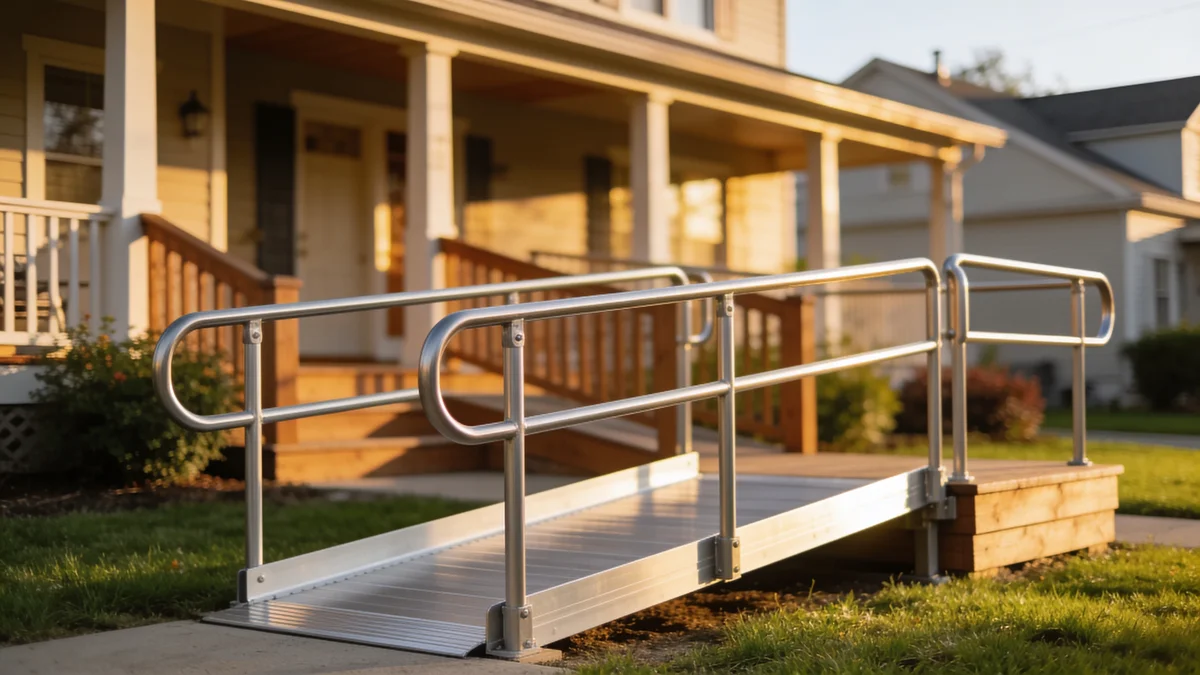
Article images are AI-generated illustrations. Some may include AI-generated people; they are illustrative and do not depict real caregivers, patients, experts, or FamilyCareWise contributors.
TL;DR: Threshold ramps bridge a sill or low step. ADA standards add handrails above a 6-inch rise, landings at both ends of every run, and a second run above 30 inches. Medicare's durable medical equipment list has no ramp entry; confirm at 1-800-MEDICARE. VA HISA grants cover permanent ramping, not portable.
Measure the rise first, ground to doorway. The ADA standard, written for public buildings and used at home as a benchmark, allows 1:12 at most: one foot of ramp per inch of rise. A 24-inch porch needs 24 feet.
Three steps to a front door stay invisible until the day someone comes home from the hospital and cannot climb them. The search usually starts with products: a rubber wedge, a folding aluminum ramp, a contractor's quote. Which of those is even possible is settled by one number about the house.
Measure the rise before shopping
The rise is the vertical distance from the ground, or from the lower landing, up to the surface the ramp has to reach. Measure it in inches, and measure vertically. A path that has settled or slopes away from the house will give a shorter number if the tape follows the ground.
The rise sets everything else. Section 405.2 of the 2010 ADA Standards for Accessible Design reads: "Ramp runs shall have a running slope not steeper than 1:12." One inch of rise buys one foot of ramp. A 6-inch step needs 6 feet. A 24-inch porch needs 24 feet.
The quick arithmetic: at 1:12, the length of the ramp in feet is the same number as the rise in inches. This is our arithmetic from the ratio in section 405.2, which states the slope as a ratio and not as a percentage or a length table. Measure the rise, and the minimum ramp length is already known before any product page is open.
Two limits in the same section are easier to miss and they change the shape of a long ramp. Section 405.6 says the rise for any ramp run "shall be 30 inches (760 mm) maximum." Section 405.7 requires landings at the top and the bottom of every ramp run. Section 405.7.3 sets a minimum landing length of 60 inches, and section 405.7.4 requires a 60-inch by 60-inch landing where a ramp changes direction between runs. Once a porch clears 30 inches of rise, a single straight run no longer satisfies the standard, and the design becomes two runs with a landing between them.
The 1:12 rule comes from a standard written for public buildings
The scope of that standard is worth stating plainly, because it changes how to use the number. ADA.gov describes the 2010 Standards as setting minimum requirements "for newly designed and constructed or altered State and local government facilities, public accommodations, and commercial facilities to be readily accessible to and usable by individuals with disabilities." A private house is not on that list. The rules that legally apply to a family home are the local building code and the local permit process, and those vary by city and county.
So 1:12 is a benchmark at home, and the benchmark still describes what a wheelchair can climb. The same section carries an advisory that says as much: "To accommodate the widest range of users, provide ramps with the least possible running slope." The standard's floor is worth knowing too. Table 405.2 permits a slope steeper than 1:12 only at existing sites where space is limited, and only up to 1:10 for a rise of 6 inches maximum, or 1:8 for a rise of 3 inches maximum. The table legend states: "A slope steeper than 1:8 is prohibited."
Four more requirements in section 405 describe what a usable ramp has besides its slope. Section 405.5 sets a clear width of 36 inches minimum, measured between the handrails where handrails are present. Section 405.8 requires handrails on ramp runs with a rise greater than 6 inches, and section 505.2 states that handrails "shall be provided on both sides of stairs and ramps." Section 405.9 requires edge protection on each side of ramp runs and landings. Section 405.9.1 can satisfy that by extending the ramp surface 12 inches beyond the inside face of the handrail, an extension its advisory explains "prevents wheelchair casters and crutch tips from slipping off." Section 405.3 caps the cross slope, the sideways tilt across the direction of travel, at 1:48.
Threshold ramps are the smallest fix on the list
When the only barrier is a raised doorway sill, a sliding-glass-door track or one low step, the fix is a threshold ramp. It is a small wedge, usually rubber or aluminum, set against the obstacle. Nothing is built and nothing is fastened to the house. This is the category families skip past on the way to bigger projects, and for a doorway it is often the whole answer.
The arithmetic still applies, and it is why threshold ramps stay small. At 1:12 a 2-inch sill wants 2 feet of ramp, which a wedge can deliver. A 4-inch step wants 4 feet, which most wedges cannot. The ADA table is the check here: a rise of 3 inches is the largest the standard will accept even at its steepest existing-site allowance of 1:8. A wedge that spans a 6-inch step in 18 inches of length is steeper than anything in that table.
Portable ramps cover a step or two and travel between houses
A portable ramp folds along its length or across its middle so it can be carried and stored. It suits the household that needs a ramp in more than one place: at home, at a sibling's house, at the car. It also suits a barrier of one or two steps. Weight rating matters, because the rating has to cover the person and the chair or scooter together.
Check the length against the rise, not against the trunk: a 2-foot portable ramp laid against a 12-inch rise produces a 1:2 slope. The ADA table stops at 1:8 and its legend states that anything steeper is prohibited, and that ceiling was written for public buildings with maintained surfaces. Short ramps sell well because they store easily. Match the length to the rise using the 1:12 arithmetic above, then see which ramps are long enough.
Permanent and modular ramps carry the rises the others cannot
Above a couple of steps, the ramp becomes a structure. Modular ramps are prefabricated aluminum sections bolted together on site. Their appeal for families is that they come apart again, so they can be extended, reconfigured or removed when the need changes. Permanent ramps are built from wood or concrete and become part of the house.
Cost tracks length, and length tracks the rise, which is the practical reason the measurement comes before the quotes. We are not printing dollar figures for ramps or installation here. We could not find current ramp pricing from a source worth citing, and a stale price would mislead. Get two or three written quotes for the length the arithmetic gives, and ask each contractor how they are handling landings, handrails and edge protection.
The permit question belongs in the same conversation. A permanent exterior ramp is construction. Whether it needs a permit and an inspection is decided by the local building department, and the ADA Standards do not settle it.
Who pays for a ramp?
Coverage answers belong to the specific person, plan and state, so confirm this one before spending, at 1-800-MEDICARE (1-800-633-4227) or in a plan's own coverage documents. Here is what the published rules say. Medicare.gov describes Part B as covering medically necessary durable medical equipment, and defines that as equipment that is durable, "used for a medical reason," "typically only useful to someone who is sick or injured," used in your home, and "expected to last at least 3 years." Ramps are not among the covered items it lists, though that list is introduced as one that "isn't limited to" its entries.
The definition is where the answer sits. The CMS Medicare Benefit Policy Manual, Chapter 15 states that "equipment which is primarily and customarily used for a nonmedical purpose may not be considered 'medical' equipment for which payment can be made," and it names "self-help devices (such as safety grab bars)" as nonmedical in nature. That naming is the reason a grab bar and a ramp sit on a different side of the line from a walker. Our guide to grab bars covers the installation side of that one.
CMS also publishes a Durable Medical Equipment Reference List, in a version effective 06/09/2025, that dispositions items one by one. "Elevators" carries "Deny - convenience item; not primarily medical in nature," and "Stairway Elevators" carries "Deny - (See Elevators.)" Ramps have no entry on that list at all, which is part of why families get different answers from different people.
A Medicare Advantage plan is a different question from Original Medicare. A CMS guidance memo to Medicare Advantage organizations dated April 24, 2019, "Implementing Supplemental Benefits for Chronically Ill Enrollees," permits structural home modifications as a special supplemental benefit where they have "a reasonable expectation of improving or maintaining the health or overall function of the chronically ill enrollee," and gives "permanent mobility ramps" as one of its examples. That memo tells plans what they may offer. Whether a specific plan offers it this year is answered by that plan's benefit documents.
Medicaid varies by state, and the variation is the point. Medicaid.gov describes 1915(c) home and community-based services waivers as programs for people who would otherwise meet the state's level-of-care requirements for an institution, says about 257 waiver programs are active nationwide, and says states "can also propose 'other' types of services that may assist in diverting and/or transitioning individuals from institutional settings into their homes and community." Which services a state's waiver actually includes, and whether it has a waiting list, is a question for that state's Medicaid office.
Veterans have a specific benefit, and it changes the order of the decisions
VA's Home Improvements and Structural Alterations benefit, HISA, is a lifetime benefit administered by the Prosthetic and Sensory Aids Service. Its stated purposes include "improving entrance paths or driveways in immediate area of the home to facilitate access to the home through construction of permanent ramping." VA states that $6,800 will be approved to address a service-connected disability, a compensable disability treated "as if" it were service-connected, or a non-service-connected disability where the beneficiary has a service-connected disability rated at least 50 percent, and that $2,000 will be approved to address a disability not covered above.
Now the part that cuts against the advice three sections up. The same VA page lists what HISA excludes, and the list names "removable equipment or appliances such as portable ramps; porch lifts, and stair glides." Buying the fast, cheap portable ramp is the reasonable first move for most families. It is the wrong first move for a veteran who may qualify, because the item that solves the problem this week is the item HISA will not reimburse. For a household with a veteran in it, the call to the local Prosthetic and Sensory Aids Service comes before the purchase, not after it.
A HISA application needs a prescription written or approved by a VA physician, VA Form 10-0103, a written itemized estimate of costs, and a color photograph of the unimproved area. A renter also needs a signed and notarized statement from the owner authorizing the alteration. VA notes that an inspection of the site by VA may be warranted.
The larger VA housing grants are a narrower door than they look. VA's disability housing grants page puts the Specially Adapted Housing grant at up to $126,526 for FY 2026 and the Special Home Adaptation grant at up to $25,350 for FY 2026, and both require a qualifying service-connected disability from a short list: loss or loss of use of more than one limb, blindness in both eyes with 20/200 visual acuity or less, certain severe burns, and a small number of other conditions. A parent who needs a ramp because of arthritis or a stroke is not addressed by those two grants. HISA is the benefit that reaches that situation.
Matching the ramp to the barrier
Start with the rise in inches and name the barrier out loud. A sill or one low step is threshold-ramp territory and can be solved this week. One or two steps, with a need for the ramp in more than one place, points to a portable ramp long enough for the arithmetic. A porch, or any rise that will still be there next year, points to a modular or permanent ramp designed by someone who does this work. Landings, handrails, edge protection and the permit are all part of it.
What rolls up the ramp matters as much as the ramp. A rollator, a manual wheelchair and a mobility scooter have different widths, turning circles and weights. The 36-inch clear width in section 405.5 is a minimum for a ramp run, not a promise that a specific scooter turns comfortably at the top. Our mobility aids guide covers walkers, rollators and wheelchairs and how families end up choosing between them.
An occupational therapist can look at the entrance and the person on the same visit. Under Medicare & You 2026, "Medicare covers medically necessary therapy to help you perform activities of daily living (like dressing or bathing)" when a doctor or other qualifying provider certifies the need, and the handbook adds that the patient pays 20% of the Medicare-approved amount with the Part B deductible applying. That is coverage for the evaluation, and it is a separate question from coverage for the ramp.
Who this is for: family caregivers deciding how to get a parent with a wheelchair, walker or mobility scooter in and out of the house. It is general information and not medical, legal or construction advice. A permanent ramp needs a site assessment by a qualified contractor and, in most jurisdictions, a permit.
One note on sequencing. Each of the routes above starts from the rise in inches, so measuring it is the step that comes before the first phone call.
Frequently Asked Questions
What slope does a home wheelchair ramp need?
Section 405.2 of the 2010 ADA Standards for Accessible Design says ramp runs shall have a running slope not steeper than 1:12, which is one foot of ramp length for every inch of vertical rise. Those Standards are written for government facilities, public accommodations and commercial facilities, not for private homes, so at home the ratio is a design benchmark and the local building code is the rule that applies. The Standards' own advisory asks designers to provide ramps with the least possible running slope. Table 405.2 allows steeper slopes only at existing sites, up to 1:10 for a rise of 6 inches maximum and up to 1:8 for a rise of 3 inches maximum, and its legend states that a slope steeper than 1:8 is prohibited.
How long does a wheelchair ramp need to be?
At the 1:12 slope in section 405.2 of the 2010 ADA Standards for Accessible Design, the length in feet equals the rise in inches. A 6-inch step needs 6 feet of ramp, and a 24-inch porch needs 24 feet. Two other limits in the same section change the shape of a long ramp: section 405.6 caps the rise of any single ramp run at 30 inches, and section 405.7.3 sets a minimum landing length of 60 inches, with a 60-inch by 60-inch landing where the ramp changes direction. A porch higher than 30 inches therefore needs more than one run with a landing between them. Local building codes govern a private home, so confirm the numbers with the building department before construction.
Does Medicare pay for a wheelchair ramp?
This is a coverage question to confirm for the specific person and plan before spending, at 1-800-MEDICARE (1-800-633-4227) or in the plan's own coverage documents. What the published rules say: Medicare.gov describes Part B as covering durable medical equipment, defined as equipment that is durable, used for a medical reason, typically only useful to someone who is sick or injured, used in your home, and expected to last at least 3 years. The CMS Medicare Benefit Policy Manual states that equipment which is primarily and customarily used for a nonmedical purpose may not be considered medical equipment for payment, and it lists self-help devices such as safety grab bars as nonmedical in nature. CMS's Durable Medical Equipment Reference List denies elevators and stairway elevators as convenience items and carries no entry for ramps. A Medicare Advantage plan is a separate question, covered in the next answer.
Can a Medicare Advantage plan or Medicaid cover a ramp?
Both are plan-by-plan and state-by-state questions to confirm with the plan or the state Medicaid office before spending. A 2019 CMS guidance memo to Medicare Advantage organizations permits structural home modifications as a special supplemental benefit for chronically ill enrollees, naming permanent mobility ramps as an example, where the item has a reasonable expectation of improving or maintaining the enrollee's health or overall function. Whether a particular plan offers that benefit in a particular year is a question for the plan's benefit documents. On the Medicaid side, states run home and community-based services waivers for people who would otherwise need institutional care, and Medicaid.gov says states can propose other types of services that help people move to or stay in their homes and community. What each state's waiver includes, and whether there is a waiting list, is a question for that state's Medicaid office.
Can a VA grant pay for a wheelchair ramp?
Eligibility is determined by VA, so confirm it with the local Prosthetic and Sensory Aids Service before spending. VA's Home Improvements and Structural Alterations benefit, HISA, is a lifetime benefit that covers improving entrance paths or driveways in the immediate area of the home through construction of permanent ramping. VA states that $6,800 will be approved to address a service-connected disability, a compensable disability treated as if it were service-connected, or a non-service-connected disability if the beneficiary has a service-connected disability rated at least 50 percent, and that $2,000 will be approved for a disability not covered above. HISA excludes removable equipment such as portable ramps, porch lifts and stair glides, so a portable ramp bought first is not reimbursed later under this benefit. The application needs a prescription written or approved by a VA physician, VA Form 10-0103, an itemized cost estimate, and a color photograph of the unimproved area.
The information on this page is for educational purposes only and does not constitute medical, legal, or financial advice. Every family's situation is different. Please consult a qualified healthcare provider, licensed attorney, or certified financial planner for guidance specific to your circumstances.